
Herriman Records Open to the Public
Herriman is a city within Salt Lake County, not a separate county records district. That split places city minutes, ordinances, permits, and city police files with municipal offices. Deeds, parcel rolls, marriage licenses, elections, and jail information sit at county level. Utah agencies keep court indexes, professional licenses, corporations, corrections files, and vital certificates. The table leads with the keeper because a well-written request sent to the wrong office still fails.
| Record group | Official keeper | Web discovery | Other access |
|---|---|---|---|
| City minutes, notices, permits | Herriman Recorder or department | Posted meetings and notices | City GRAMA inspection or copy request |
| Deeds, liens, plats | Salt Lake County Recorder | Free list; paid Data Services detail | Counter, written copy order, Archives |
| Property roll and parcel GIS | Salt Lake County Assessor | Free owner, address, and parcel search | Assessor counter and phone |
| Justice and district cases | Utah Courts and filing clerk | Paid Xchange | Free public terminal; clerk copy request |
| Birth, death, marriage, divorce | Utah Vital Records, county offices, court | Public historical indexes | Online, mail, counter, or Archives |
| Voter registration | County Clerk and Lieutenant Governor | Authenticated personal lookup | County list request or state data order |
| Jail, corrections, registry | County Sheriff, UDC, DPS | Separate official name systems | Agency records request or notification service |
| Licenses and businesses | DOPL and Utah Corporations | Free name and entity searches | Regulator verification or certified order |
Public status is not the same as web access. An index may disclose that an instrument or case exists while the image or certified copy costs money. Some files also mix open and protected facts. Utah law directs a custodian to separate releasable portions when practical. A missing online result can instead reflect a date limit, spelling variation, transferred archive file, or office-only record.
Herriman's Three Records Layers
The Herriman City Recorder administers legislative actions, elections, and city GRAMA compliance. The Recorder also routes marriage and parcel questions outward because City Hall does not hold those county series. Herriman Police handles incident records through its own records unit. Herriman Justice Court keeps limited-jurisdiction files for traffic matters, small claims, class B and C misdemeanors, infractions, and city ordinances. Salt Lake County holds the main land, tax, marriage, election, and jail trails. State systems add district-court cases, vital certificates, licenses, corporate filings, and correctional records. Event date can change the answer. Herriman incorporated in 1999, and the Olympia annexation took effect in 2022 after the land had been unincorporated. Older planning material for a present Herriman address may therefore remain with Salt Lake County.
The city Recorder source shows the local office and its routing role.
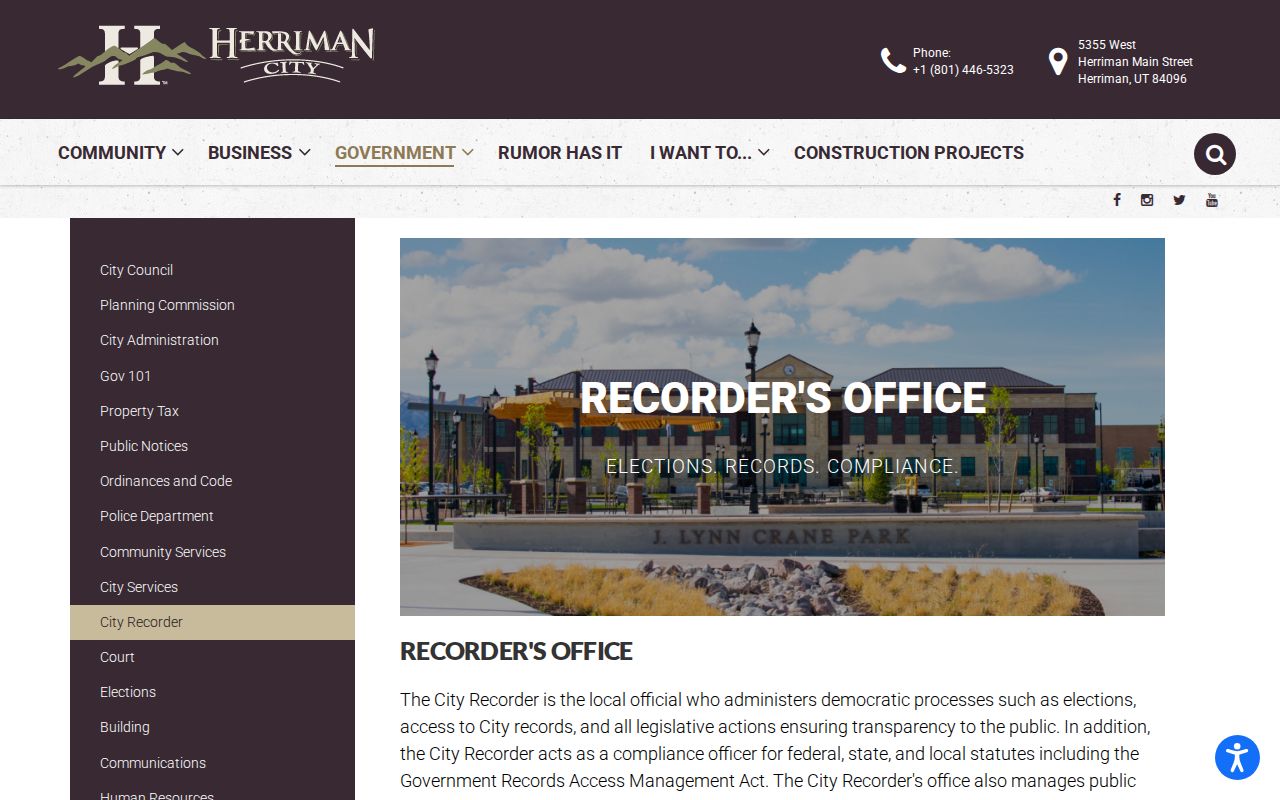
Its contact details make the Recorder the sound starting point for city minutes, ordinances, and administrative files, but not for county deeds or state court cases.
Herriman City GRAMA Record Fields
The current Herriman GRAMA form asks for the requester's name, mailing address, daytime phone, email, and a clear description of the material. It has a date-range field and separate choices to inspect records or receive copies. A requester may authorize costs only up to a stated amount. Expedited treatment needs an explanation showing that the request primarily benefits the public.
City permit or planning requests work best when tied to an address, project, meeting body, date, and agenda item. Police incident requests can be made in person, by form, or by mail. They should identify the case number or incident date and address, the known parties, and each desired item, such as the report, photographs, or body-camera material. Investigative, victim, and security facts may be withheld or redacted.
Utah's normal GRAMA response limit is ten business days. It is five business days for a demonstrated primary public benefit, subject to extraordinary circumstances. The agency may provide the record, deny access with legal reasons, say it does not keep the file, or give an estimated completion date. Silence after the applicable limit is treated as a denial for appeal.
Note: Herriman does not publish a separate request-tracking portal, so retain the submitted form, attachments, delivery proof, and all agency replies.
Herriman Deed Records and Recorder Access
The Salt Lake County Recorder keeps deeds, liens, recorded documents, legal descriptions, parcel-number history, chains of title, subdivision maps, and plats. Free Search gives a quick document list when an address or parcel number is known. Recorder Data Services adds the deeper record trail through a paid session. The official landing page does not state the earliest online index year, so no reliable start year should be inferred. A $5 token supplies 150 data units and expires when used up or after 24 hours. One search, abstract, or document page generally uses one unit. A plat or map page uses 20. Larger packages are available, but the short session is the practical bridge for a focused Herriman parcel. Recorded documents cost $2 per page when ordered. A certified copy adds a $5 certification charge, and historical vault pages cost $5 each.
The official Data Services screen explains the available property-record paths.
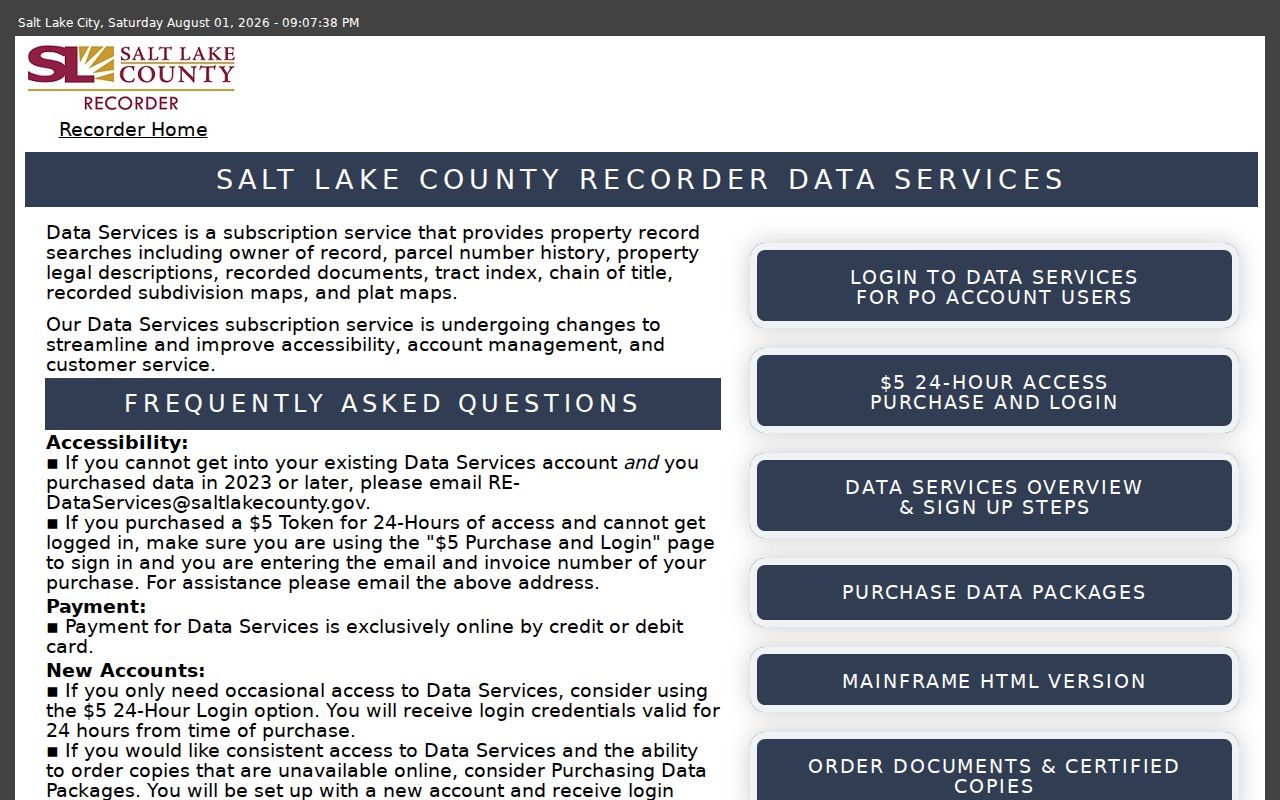
The screen matters because free discovery and full title detail are different service levels. For a paper or certified copy, supply a document number or book and page. If those are unknown, the copy-order form accepts party names, dates, document type, and index or abstract references. Counter service and written orders remain valid when the portal is not enough.
Herriman Property Records Start Free
Start with the free Salt Lake County Assessor search when only an owner or street is known. Enter at least three letters for an owner and use the format Surname, First. Address fields can be split into frontage number, direction, street, and type. A parcel ID may use its first ten digits, with four optional encumbrance digits; seven digits can return a block.
| Portal field | Input type | Required? | Format or result |
|---|---|---|---|
| Owner Name | Text | Optional route | Three-letter minimum; Surname, First |
| Frontage Number | Text | Optional | May begin an address search |
| Street Name or Number | Text | Optional | Like-value matching |
| Direction and Type | Selector or text | Optional | Narrows street components |
| Parcel ID | Text | Optional route | Ten core digits; fourteen with extension |
| Display | Choice | Optional | Classic or printable detail |
The Assessor controls below turn a name or address into the stable parcel key used by the Recorder.
That handoff is the useful insider route: free owner search, saved parcel ID, then a Recorder list or paid title detail. The assessment roll shows current tax-roll evidence. It does not prove legal title, and an account or mailing address does not prove where a person lives.
Herriman Parcel Maps Need Context
The county parcel GIS gateway accepts an address or 14-digit parcel ID and offers map layers, a query builder, imagery, street view, selection, export, and printable output. Queries can use parcel ID, owner, property type, or tax district. Herriman's own ArcGIS data adds city limits, roads, zoning, subdivisions, permits, and alternate-address fields.
The map gateway shows the geographic tools available for a Herriman parcel.
Map geometry is best used to confirm a parcel, district, or city boundary before a request. Corner lots can carry two early address choices until the building front fixes the permanent address. A present address may also hide older county custody after annexation. For title, return to recorded instruments; for old ownership, ask County Archives for tax ledgers containing parcel number, owner address, property location, and legal description.
Herriman Court Records Online or Free
Utah Xchange searches public district and justice case summaries statewide. Remote use is paid, while public access is free at most district courthouses and at the Utah State Law Library. That free terminal option is easy to miss. Herriman Justice Court is the local keeper for its limited cases; Third District Court handles general jurisdiction, probate, divorce, and more serious criminal matters.
| Xchange control | Kind | Needed? | Use |
|---|---|---|---|
| Jurisdiction | Choice | No | District, Justice, or both |
| Last name/Company | Text | Name route | Exact last or company name |
| First Name | Text | No | Asterisk finds variants |
| Search Scope | Dropdown | No | State, county, or court |
| Case Type | Dropdown | No | Official case codes |
| Date Range | Panel | No | Limits broad results |
The court's illustrated Xchange screen demonstrates the real search and result layout.
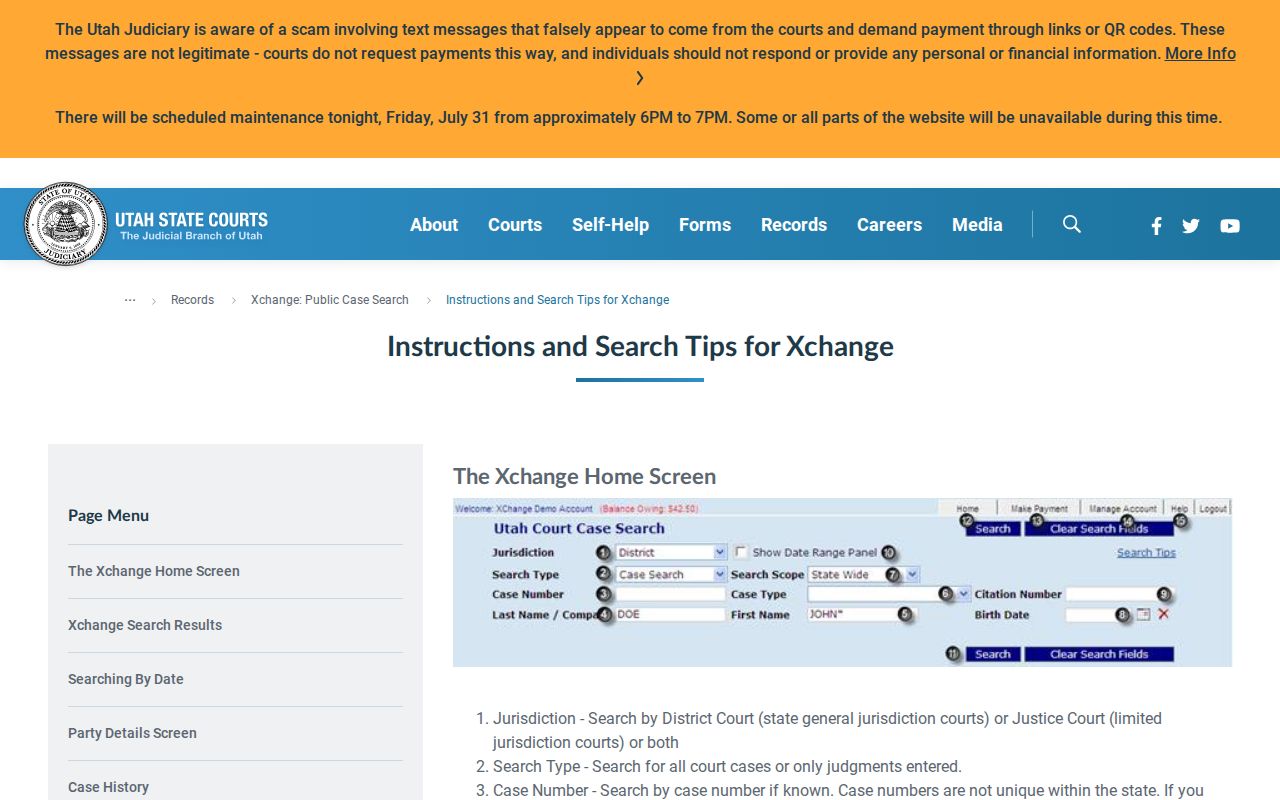
Results stop at 500, so narrow common names by court, county, case type, or date. A result may show court, case type, number, filing date, party, role, and a history link. Online use begins with a $10 credit, then costs $0.35 per search and $1 per available PDF. Most district cases are generally complete from the late-1990s CORIS conversion, but justice-court start dates vary.
Order Herriman Court Record Copies
Xchange is for discovery, not a substitute for every filed item. Request the actual record from the court where the case was filed. Include the case number, caption, exact document, filing date, delivery format, and whether a regular, certified, or exemplified copy is required. Private material needs proof of authority and may not be sent by email.
Court paper copies cost $0.25 per sheet. Email or fax costs $5 through ten pages, then $0.50 per page, except for records available through Xchange. Certification is $4 per document plus $0.50 per page. The first 15 minutes of staff work are free; later research time follows the published staff schedule.
Sealed, expunged, adoption, civil-commitment, juvenile delinquency, child-welfare, and parental-rights cases do not appear in Xchange. Sensitive contents in some family, stalking, and guardianship matters are private even when a public order, decree, hearing minute, or letter of appointment remains available. Historical transferred court and probate files route to Utah Archives.
Note: Federal District of Utah cases use PACER and remain separate from Herriman Justice Court, Third District Court, and Utah Xchange.
Herriman Vital Records Access Periods
Recent vital certificates have access rules even when an older index is public. Utah birth records become public after 100 years, deaths after 50 years, and marriage or divorce certificates after 75 years under Utah Code § 26B-8-125. Salt Lake County Health issues local birth and death copies. The County Clerk keeps marriage licenses, Third District Court keeps divorce decrees, and Utah Vital Records supplies statewide certificates and 1978 through 2010 marriage or divorce abstracts.
The Utah certificate access page lays out coverage, eligibility, and order channels.
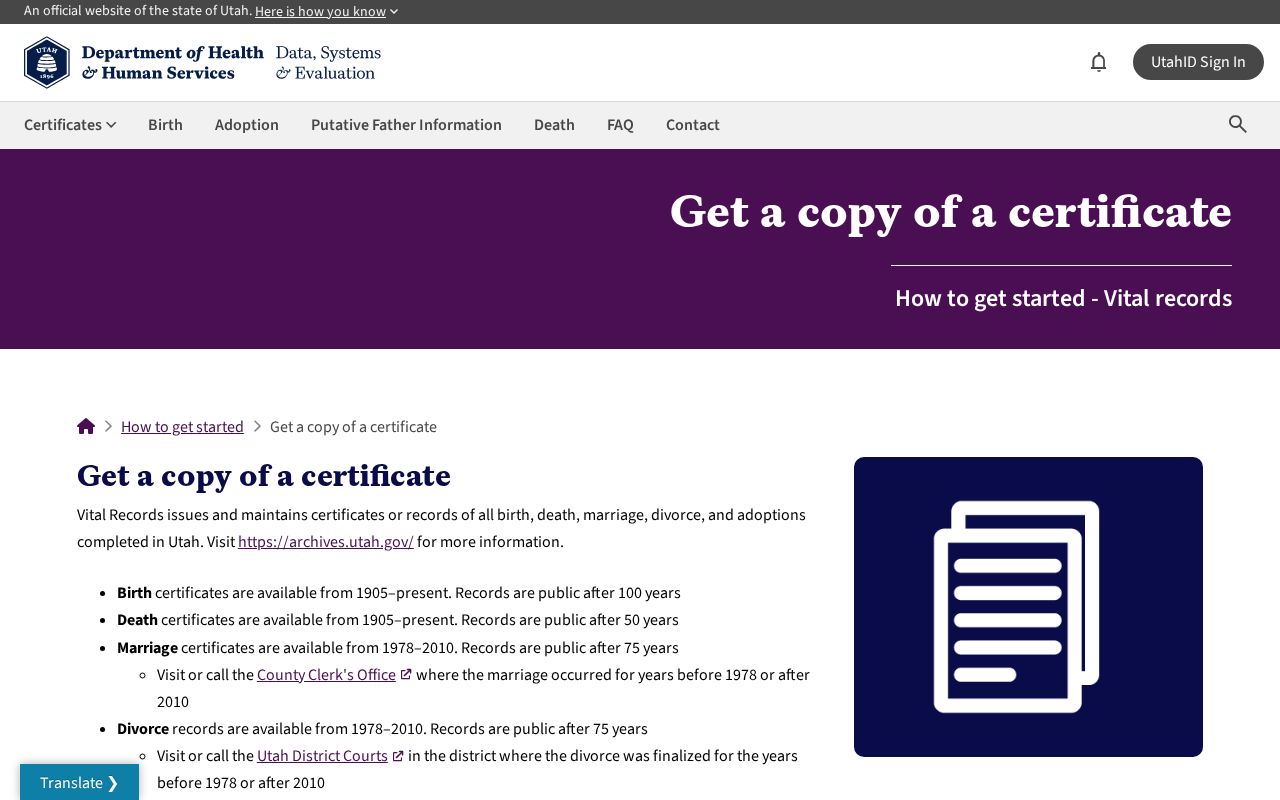
Recent copies require identification and a qualifying family, legal, or authorized relationship. Orders may be placed online, by mail, or in person. Fees effective July 1, 2026 are $25 for an initial birth certificate, $35 for a death certificate, and $25 for a marriage or divorce abstract. A failed search yields a certificate of search rather than a refund. Public Archives indexes help with older events, but an index entry is not a certified certificate.
Herriman Custody and Registry Records
Current jail, state corrections, and statutory registry information use three distinct channels. The Salt Lake County Sheriff prisoner search covers county detention. Utah Department of Corrections search covers current state incarceration plus probation or parole, but not an unsentenced county detainee. Its name mode requires at least one letter in both first and last names; an offender number is the alternate route.
Displayed correctional results may include date of birth, legal status, offender number, facility placement, offenses, sentence range, board hearing, parole or expiration date, committing court, and case. Utah VINE offers a separate free, round-the-clock notification route by name or offender number. It can alert registrants to release, escape, return, death, parole release, or transfer.
The state offender registry uses a surname and postal-code index and publishes only the fields authorized by law. Victim-identifying data is redacted. Registry access comes with a warning against threats or harassment. A public record never grants permission to monitor, intimidate, or harm a person.
Herriman Public Records Office Routes
Use the office that created or now holds the record. City Hall can handle municipal administration and city police routing. County offices share the Government Center for land and parcel work. The filing court controls its own copies. Calling first is useful when a file date crosses incorporation, annexation, system conversion, or archive transfer.
Herriman City Recorder
5355 W Herriman Main Street
Herriman, UT 84096
801-446-5323
City records and GRAMA
Weekdays, 7:30 a.m. to 5:30 p.m.
Salt Lake County Recorder
2001 S State Street, Suite N1-600
Salt Lake City, UT 84190
385-468-8145
Deeds, liens, plats, copies
Weekdays, 8 a.m. to 5 p.m.
Salt Lake County Assessor
2001 S State Street, N2-600
Salt Lake City, UT
385-468-8000
Owner, address, parcel, and GIS records
Herriman Justice Court
5355 W Herriman Main Street, Room 2100
Herriman, UT 84096
801-446-5323
Limited-jurisdiction case files
Weekdays, 7:30 a.m. to 5:30 p.m.
The Salt Lake County Recorder and Assessor keep separate suites and separate record functions at the same State Street complex. Saving the office name with each result prevents an assessment entry from being mistaken for a deed or a city file from being sent to the county.
Herriman Records Closed or Redacted
GRAMA classifies records rather than making all government material open. Recent vital certificates require eligibility and ID. Courts exclude sealed and expunged matters and keep juvenile, adoption, and sensitive family material private. Driver information is controlled by federal DPPA rules. At-Risk voter identities and addresses are withheld, while police may redact victim, investigative, and security facts.
- Custodian
- The agency or office responsible for a record and its access decision.
- Index
- A finding list that points to a record; it may not include the underlying image.
- Certified copy
- A copy authenticated by the keeper for an official purpose.
- Exemption
- A legal basis for withholding all or part of an otherwise responsive record.
Not online does not mean closed. Ask for inspection, a segregated copy with protected parts removed, an office terminal, or an archive search. Negative results also need care. A miss can stem from an old locality name, maiden or business-name variant, incomplete converted case, portal input rule, or a record kept under Salt Lake County rather than Herriman.
Utah Safe at Home provides a substitute address and mail forwarding for eligible victims and qualifying household or guardian applicants. Government offices generally accept that substitute, and disclosure of the actual address is tightly limited. The Utah Consumer Privacy Act creates certain rights against covered commercial data controllers, but it does not erase source records held by government custodians.
Use records lawfully. Open access supports family research, property review, scam checks, and civic oversight. It does not permit stalking, threats, harassment, or attempts to rebuild protected data from separate sources.
Request Herriman Public Records with GRAMA
Utah Code Title 63G, Chapter 2 allows any person to inspect a public record during normal hours, subject to lawful restrictions. A focused request reduces search time and cost. GRAMA fees must reasonably reflect actual duplication or compilation work, use the lowest-paid capable worker, and ordinarily leave the first quarter-hour free. Prepayment may be required above $50 or after prior unpaid fees.
- Find the true keeper. Send city minutes and permits to Herriman, deeds to the county, and court documents to the filing clerk.
- Collect stable identifiers. Save the parcel, document, meeting item, incident, case, certificate event, or license number from an index.
- Describe the exact material. Give names and variants, an address, date range, document types, and the desired electronic or paper format.
- Choose inspection or copies. Provide the required contact and residency statement, ask for segregated public portions, and set a cost ceiling.
- Track the response date. Note the ten-day limit, any valid five-day public-benefit claim, and any extraordinary-circumstances estimate.
- Appeal a denial. Attach the decision and appeal to the chief administrative officer, generally within 30 days.
A denial or fee-waiver denial can proceed through the current Government Records Office review path. Mediation is available through the Government Records Ombudsman, and district-court review remains an option. Court records follow the Utah Code of Judicial Administration rather than every GRAMA deadline, so use the court request and review process for judicial files.
Note: Keep public and certified access separate; a free index hit proves a lead exists, while the keeper's copy establishes the official record.